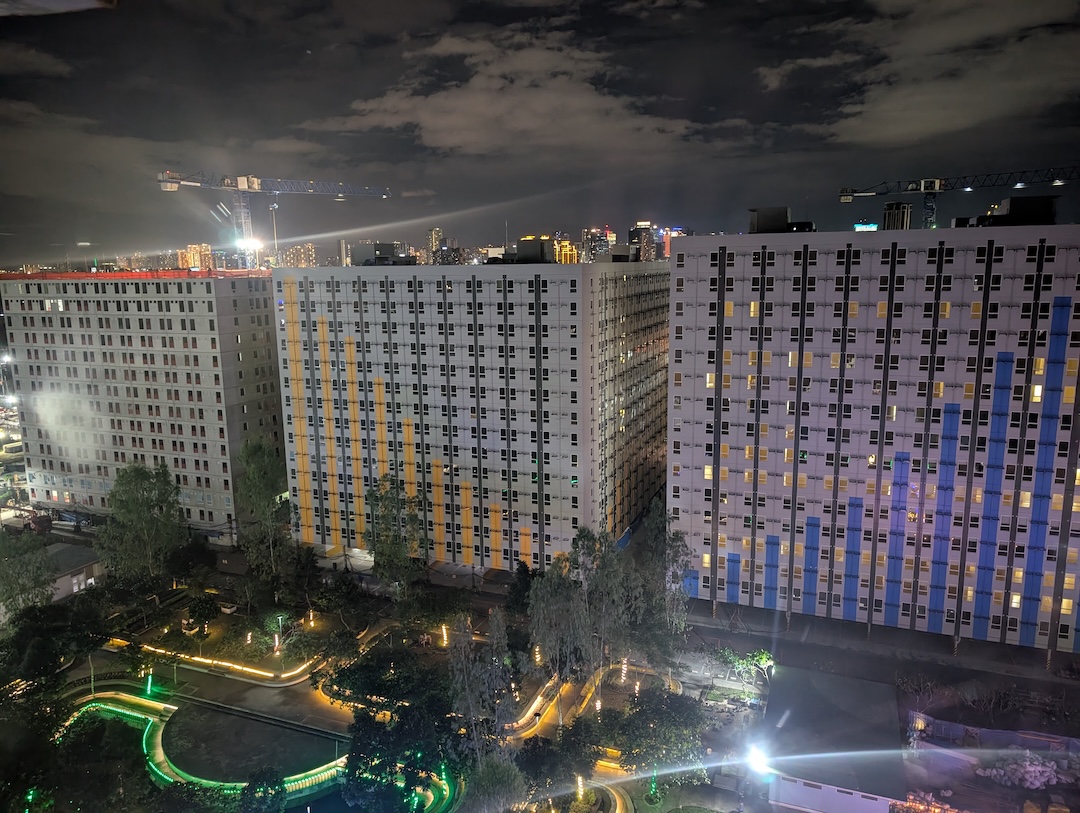

Our time in Manila Philippines has been spent entirely in one place, which is a condo complex called Urban Deca Homes Ortigas. We basically became trapped in this complex and the immediate area, which I’ll explain in more detail below. Due to this, we didn’t get to explore all or even much of Manila. While I can’t give a thorough review of Manila as a whole, I do have a lot to say about Urban Deca Homes Ortigas.
Complex
Urban Deca Homes Ortigas (UDHO) is a condo complex that is marketed as affordable, with their consumer being lower-middle to middle income (Filipino income). Their stated target consumer is young urban professionals, and I definitely see that demographic represented. It is not low income housing, or government housing (i.e. projects), but is most definitely meant to be affordable. I make this distinction because in America if we were to see a complex with this density and affordability in a major city, it would probably be section eight housing. UDHO is actually in stark contrast to that. Whereas American government subsidized housing is somewhere you don’t want to be, UDHO is a refuge from the surrounding area.
Grounds
The complex and all of its buildings sit on a footprint that is the size of a few city blocks, probably around 15 acres of ground if I were to guess at the size. It consists of 18 identical buildings, at least by the building letters that I know exist. I see a building R, so I assume there is an A through R set of buildings. However, I can only see 11 buildings in our immediate area. Some of these buildings may be planned but not started yet. There are reportedly about 19,000 condos in the complex. I would have to speculate at the resident count, but I imagine it is or will be somewhere around 60,000 people.

Within the complex there are a series of one way streets around the buildings, and parking spaces under and around the buildings. The traffic flow within the complex feels orderly and light, the opposite of traffic outside of the complex.
Security
Entering the complex requires you to go through secured gates to prove you have business in the complex. Additionally you will then find security at the main outdoor entrances to each building, as well as security guards walking around the grounds. We found the security to be a nice presence and more than just a show. On several occasions when a new guard didn’t recognize us, they asked for our proof of stay. The security guards were all very friendly to us and seemed to have a good relationship with the residents.
Amenities
In the middle of the complex is a 1.3 hectare (3.2 acres) central grounds area for amenities, which includes two basketball courts, a coy pond, walking paths, playground, open field area, bodyweight exercise equipment, and a community building which includes a convenience store (Alfamart). The central grounds can get a little busy at times with so many residents, but we had reasonable access and opportunity to use everything. It only got annoying when having to dodge people while walking fast to get in steps.


Alfamart deserves a special mention because it really is a lifesaver. Given how difficult it can be to navigate out of the complex and to make it back to the complex, Alfamart is an essential utility. We bought all of our water and many fruits and vegetables here. Without Alfamart we would have had to use another separate water service since the tap water isn’t potable. While Alfamart pales in comparison to a Japanese Lawson, we were very grateful for this store.

Buildings
Each building has 14 or 15 floors, although in the elevator you will see 16-17 floors because they count the ground floor as floor #1 and they skip unlucky floor #13. There are 64 units per floor arranged in this way:

The buildings are constructed of concrete, which includes the walls between the units. This provides one of the best features of this complex, the lack of noise within the units. This place is very densely packed, and we almost never heard our neighbors through the walls, floor, or ceiling. AC didn’t have to be intentionally quiet here like in other locations. We also found our unit to be pest free, and I suspect the concrete construction helps with that as well.
In each corner of the building there is an elevator (red circles in image) which provides good response times and redundancy. This complex may be densely packed with people but we rarely had to wait long for an elevator. Also we only skipped rides due to a full elevator a couple times in 28 days.
Our Airbnb
I need to talk about our Airbnb unit from a couple different angles. It was simultaneously a great value for the money and the worst spot we will stay this year. It was incredibly nice and it was torture.
The unit itself is a two bedroom one bath “dressed up” unit. It has 35 square meters (376 square feet) of living space, making it very small by American standards. The quality inside the dressed up unit made it feel much nicer than similar units without that upgrade. It really improved the feel of the place between accent trim and ambient lighting. The beds in our particular unit were also fantastic as far as mattress comfort, but that of course will vary unit to unit.


The torture part of this was our own fault. At 376 square feet this is a tight fit for larger American bodies. This is just too small of a place for us to sustainably live in. We didn’t realize exactly how small this unit was until we walked in. In Tokyo we had a small place as well, but at 500 square feet and with an incredibly thoughtful and functional layout, that felt at least twice as big as this place. The bathroom, shower, and sink were all separate in Japan which made a massive difference. The strain caused by the smaller unit was amplified by the perfect storm of traffic and effective isolation of this complex. More on that later.
People
I should start leaving this section out of my posts, because I always think the people are great. The one thing I noticed so far in the Philippines that I liked is that the people are like me in one respectful way. I notice people getting out of my way when they aren’t really in the way. That is something I tend to do as well and appreciate that from them because I know their mindset from that action.
As you would expect in any place with tens of thousands of people though, there are creeps we encountered. The worst of which was a guy asking BC (while we weren’t there) for our building, floor, and unit number. There is no innocent explanation for that, and we almost left altogether because we didn’t know what he was up to. In addition to that we just stood out, and it caused people to stare at us a lot. That’s human nature though, and I’m sure I’ve been guilty of that when roles are reversed.
Cost
The cost of buying or renting in UDHO is extremely affordable. For our unit on a month long stay (28 days) through Airbnb, it cost $880.62. That is the cheapest stay we will have all year most likely. If you were to buy a unit like the one we stayed in, it would cost around $54K from listings I see. There are HOA fees of around $50/month if the info I found is correct. I’ll be doing a post later about the budget and FIRE numbers needed to live here full time as an expat.
One other angle of cost is related to the complex having a captive audience. According to a friend we made at the complex, many people rarely if ever leave the complex due to traffic. Because of that, Alfamart can charge slightly higher prices inside the complex. This slightly increased our spending which was insignificant to us, but probably an important amount to a local. Similarly, using Grab to get groceries slightly inflates costs.
Improvements
There are some things that UDHO could do to make this a first class location to stay in. These may be unrealistic in the sense they would increase the cost of units and HOA fees. However they would be enormously beneficial.
A Lawson-like store in place of Alfamart would completely change the food situation. Alfamart had some good selection of specific fruits and vegetables, but not really any other fresh or healthy foods. Something like a Lawson could be the go-to for most meals. This suggestion seems possible to me. Someone started the first Lawson, deciding there was a market for freshly made quality foods. Similarly, someone could decide to try the same thing at UDHO. I bet there is a market for it.
Not being able to drink the tap water was a tough one to get used to. For those of us not used to that, or for those who have never experienced drinking tap water, it would be a major win to have that ability. This would have required some forethought by the builder to also install a water tower for the complex. With all of the new plumbing being fed by a clean water tower, it would make for potable tap water. It would require a team to manage the water which would increase HOA costs.
Finally, a bridge from the complex over Ortigas Ave would be incredible. I don’t mean anything fancy either, just a real basic bolt-on walking bridge. If we didn’t have to cross the worst traffic street in the world to get to the mall it would be a huge convenience.
Oddities
There are some things that I’ll classify under oddities of the complex.
The number of transgender people in the complex is noticeably large. I’m from America where we don’t see that so obviously in public, so it caught my attention. If you aren’t from America you probably think we’re overrun with trans based on how much political energy is dedicated to it. In reality it’s nearly non-existent. The topic is just a tool that politicians use to stir people up into a frenzy by convincing them that trans will spread like wildfire if it’s not stopped.
The next oddity really grossed me out. At UDHO you will see all dogs wearing diapers. This rule was put in place with the best of intentions I’m sure, but ended up being far grosser than just having dog piss and dog shit everywhere. It’s a visceral reaction for me that I almost can’t explain in words. Something about a dog in a diaper is just disgusting. It doesn’t help when that diaper is often old and bulging with content.

Surrounding Area
Traffic
UDHO is ground zero for the worst traffic in the world. It is on the street with the worst traffic (Ortigas Ave), in the city with the worst traffic in the world. We really felt stuck in the complex due to this. We made a trip to BGC one day to go to the Mind Museum. When it was time to go back to UDHO we spent two hours trying to get a Grab, and ultimately failed to get one. Nobody would take our ride.
We flagged down a taxi and asked if he would take us to UDHO, and he asked “how much are you paying”. We had to pay a premium to get back, ultimately 1,000 pesos when tip was added. The Grab ride would have been 600 pesos, and the taxi driver said people wouldn’t take it because it just isn’t worth it to drive to that area.
Perfect Storm
The traffic plus a combo of other factors made for a perfect storm that made our stay here difficult. We were boxed in by traffic, and boxed into a tiny condo. We are heavy walkers and don’t like being stuck inside. Our only escape was to go walk at the amenities area, or cross traffic to go to the mall.
The amenities area had its issues as well. We really stood out and sometimes drew too much attention. At times it was also very busy and made for difficult walking. When you add in the creepy dude asking BC for our building, floor, and room number, we felt further pressure. After that happened we felt like we couldn’t leave either kid alone, even in the condo. It meant at a minimum we had to buddy up, and each individual person couldn’t do their own thing.
Final Thoughts
Ultimately with everything considered, I feel like UDHO has a lot to offer. You’ll just want to understand what you’re getting into with the surrounding area. It is a great value for the price paid, and if you are Filipino the benefits outweigh the negatives by a wide margin. The issues we had here as Americans would be non-issues for locals. A local resident wouldn’t have to feel boxed in by traffic if you had a vehicle and were used to navigating the traffic. Also, a local would just generally fit in better and become part of the community.
Leave a Reply