
This blog started with the premature FIRE experiment that was our international gap year. At the beginning, we had not hit our FIRE number at home in Colorado. We would have had a risky 4.5% withdrawal rate, having only 22 of the required 25 FU’s.
Slow traveling internationally was an adventure of its own, but also a solution to FIRE. It provided us with rental income and a slightly lower cost of living overall, boosting us to 26 FU’s or a 3.85% withdrawal rate. While this allowed us to truly FIRE while on the road, it was never intended to be a permanent lifestyle. We have family and friends in CO, and we want the kids to have a normal experience growing up in America.
The short version: we landed at a 3.84% withdrawal rate. Here’s how we got there, and what it costs us to live in Colorado.
FIRE Number Details
It was only upon returning and getting our life reestablished that we were able to assess our budget to see if our expenses are supported by our investments. It took this entire first month for that to unfold.
The financials of our return to CO were complex because we were resuming a life that we had completely shut down. There were a flurry of expenses required to kickstart our life in CO. This included buying a car, as well as a long list of move-back related expenses. We also chose to do some home renovations – removing a pony wall, replacing the carpet throughout the house, and refinishing the hardwood floors. All of those things take money, and with nowhere else to pull that money, it had to come from our investments.
Move-Back Expenses
The expenses to move back break down as follows. We had to sell enough taxable investments to free up cash to cover these expenses. A few months back we had already done this as part of capital gains harvesting.
Total: $42,586.56
| Car Purchase (Subaru Crosstrek) | $29,666.54 |
| Carpet (entire house) and Hardwood Refinish | $11,460.00 |
| Moving Van & Truck | $138.36 |
| Grocery Restock | $1,000.00 |
| Sprinkler Repairs, Pony Wall removal, move-in related expenses | $914.77 |
Pulling this money from our investments reduces our monthly 4% withdrawal by $141.96.
Finalized Monthly Expenses
As expenses were locked in through our first month back (July), we were finally able to nail down our monthly budget and determine if we hit our FIRE number.
Monthly Total: $4,326.13
| Grocery Store | $927.00 | We still aren’t 100% sure of this number. The July grocery numbers were very unclear with many meals eaten at JC’s mom’s house, and many things bought for family gatherings, etc. |
| Uncategorized | $500.00 | Sinking fund: This covers unexpected home and auto repairs, or other irregular expenses we can’t plan for. |
| Discretionary | $500.00 | Sinking fund: This is “fun” money for non-essential spending, such as vacations and travel. |
| House Escrow | $450.39 | Sinking Fund: Property taxes $3,428.62/year, homeowners insurance $1,976/year. Note that our house was paid off in 2019 so there is no mortgage. |
| Auto/Umbrella Escrow | $269.96 | Sinking Fund: Auto Insurance $2,335/year, Umbrella $455/year, Registration $350/year, AAA $99.50/year |
| Health/Dental Ins. Premium | $253.78 | $165.78 health insurance, $79 dental insurance, $9 vision insurance. This is so low because of how we are manipulating our income to work with current subsidies. The elimination of the ACA or significant subsidy regulation changes would cause a major disruption to this budget item. |
| Water/HOA | $240.00 | |
| Clothes | $200.00 | Sinking Fund |
| Taxes including Roth Conversion | $134.33 | Sinking Fund: $6,012 total taxes mainly due to upcoming Roth conversion, minus $4,400 child tax credit |
| Gifts | $120.00 | Sinking Fund |
| Car Replacement | $115.55 | Sinking Fund: Allows for a $20K inflation adjusted car purchase every 10 years. That plus trade-in value will get a decent new car. |
| Natural Gas | $100.00 | Average across the year |
| Electric | $100.00 | Average across the year |
| Life Insurance | $99.81 | |
| Phone (Google FI) | $70.00 | |
| Internet | $60.00 | |
| Gym Fund | $54.16 | Sinking Fund: Peloton subscription and rec center membership |
| Giving | $43.00 | Sponsor child in the Philippines |
| Gas | $40.00 | |
| SimpliSafe | $32.99 | This gives us a discount on our homeowner’s insurance |
| Amazon Prime | $12.17 | Sinking fund |
| Cloud Storage | $2.99 |
Investments / Withdrawal Rate
Given the expenses above and our investment totals, this puts us at a 3.84% withdrawal rate. That is strikingly close to the 3.85% withdrawal rate we had while traveling internationally. In this blog I have always avoided explicitly stating our investment totals, so I guess I’ll keep with that precedent. It may be an odd line to draw since basic math against the information in this post would reveal that number.
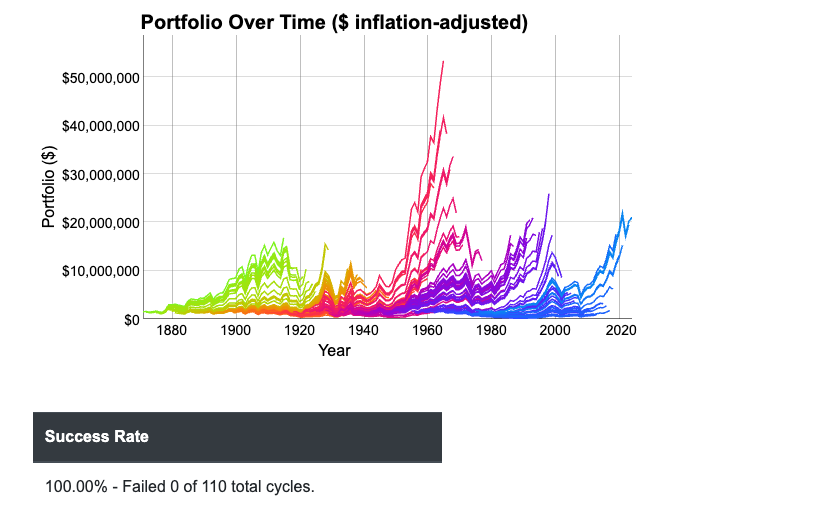
Our numbers and the resulting withdrawal rate of 3.84% gives us a 100% success rate on cFIRESim. This is with the retirement end date (i.e. death) set way out to 2070 when I’ll be 90 and certainly long dead already. This is reassuring because we aren’t targeting a 20 year or 30 year time horizon for our money to last, but a 44 year retirement. This also doesn’t even factor in JC’s social security, but it does factor in mine. Over the 110 historical cycles, none of them ran out of money, and on average we end up dying with an inflation adjusted portfolio of $10.8M.

Reflections On Our Path To FIRE
Early Years
My earliest memory of any thought along the lines of FIRE was in the early 2000s. I was only a year or two into my software engineering career, and maybe 21 or 22 years old. At the time FIRE wasn’t a term I was aware of, and I’m not sure that acronym existed yet. At this early stage I learned that my career was difficult and I didn’t know how long I could do it or would want to do it. It led to my first calculation that if I saved $1K/month into CD’s, by the time I was 40 I could have $1M saved. Setting aside the terrible investment tool (CDs), and the arbitrary $1M, it was the first realization that I could buy freedom from work.
In those early years I was not diligent about saving that $1K per month. I wasn’t mature enough to realize having a plan on paper and executing a plan were vastly different things. I also needed some time (years) for my uncle’s advice to sink in that maybe CD’s weren’t the best vehicle for growing money.
Having to take that time worked out fine though as I had other things to focus on in my early 20’s. JC and I started dating, I bought a house and finished the basement, we got married, had all sorts of fun, and it was actually great doing all of that without a care for the numbers.
Discovering Financial Systems
During these 2000’s years I also discovered Dave Ramsey which gave me the first real framework to follow. His system led me to eliminate my debt, invest 15% of my income into my 401K, pay off our house early, and was a defined set of steps that JC and I agreed on. Even though I now disagree with many things in his system (e.g. credit cards are evil, vaporize your credit score, etc), people would thrive if they would follow his system.
In the year 2016 JC and I discovered Mr. Money Mustache, and we were inspired by the intensity of his approach. At the same time that it was reigniting those thoughts of early retirement, it was discouraging to run the math and see how far away we were. I calculated it would take nine years to FIRE, which might as well be forever. Nonetheless we cut expenses and started investing harder.
Achieving FIRE
It did in fact take nine years exactly to get to the point where we could FIRE by embarking on our international gap year. If you look at the years individually, they were a long grind. In hindsight though, those nine years went pretty fast. You are going to live those nine years regardless, so it’s really a question of whether you want to be free at the end of them.
In the end we did our part, the stock market did its part, and we ended up FIRE’d on a budget I would have only dreamed of. I would have settled for lean FIRE, cutting any unnecessary expenses to force it to work. Our situation is much better than that though. We ended up with luxury budget items such as a car replacement fund, discretionary money, a healthy clothing fund, and a gym fund. This could have gone many different ways, and as far as I’m concerned this was the best case scenario.
Leave a Reply