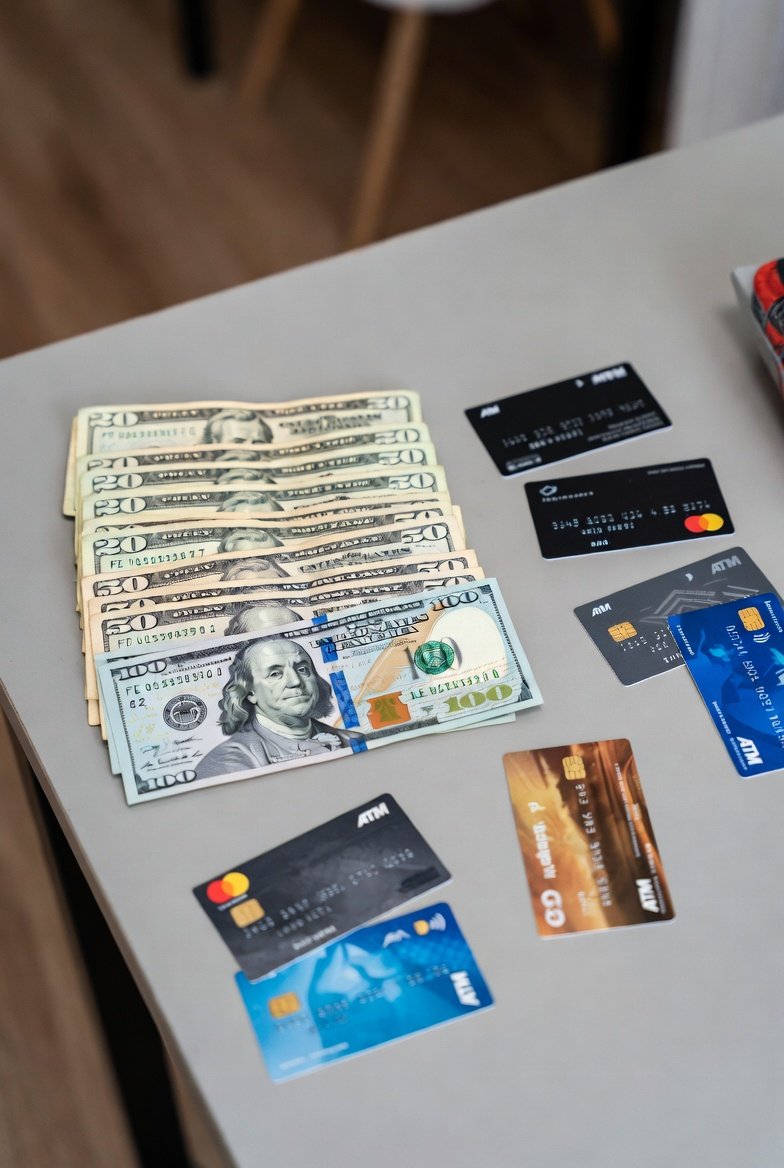

Managing money and banking while traveling internationally was one of our biggest initial concerns, and something we knew we had to get right. Many anxious thoughts entered my mind surrounding failed payment transactions, disabled accounts, or the inability to access our financial tools. That lead me to research the best tools and systems we could put in place to mitigate that without breaking our budget. I’ll walk through what has worked well, and unexpected failures we encountered.
Key tools and systems that we use which will be covered are:
- Checking accounts and debit cards
- Credit Cards
- Cash backup
- Budgeting Tool
Key Strategy
A quick comment on a general strategy we have followed with our financial tools and systems. Being sort of homeless and traveling through foreign countries is a little bit scary. From the comfort of home if any financial tool fails, it’s inconvenient but it can easily be sorted out and corrected. Internationally however, you aren’t available to do things in person, you are in a different time zone, and it’s often difficult to physically get things such as a replacement credit card.
With that in mind, we have tried to prevent single points of failure on anything critical, such as bank accounts and financial tools. You will see this theme present throughout this post.
Checking Accounts
Checking accounts are important for international travel for one main reason, which is getting cash from ATMs to have local currency. We are really only using one checking account internationally, which is Schwab Bank Investor Checking. That account has worked flawlessly. However in the spirit of preventing single points of failure, we do have Chase Total Checking as a backup.
Chase Total Checking

This was our original day to day checking account, and it has been perfectly fine for our life in Colorado. Because we have monthly direct deposits and we maintain a balance over $1,500, we have never paid a service fee (see current Chase fee schedule).
While great for our day-to-day, this account was not the best choice for international travel. It has fees for international transactions which would really add up. To get cash at an ATM would be a $5 Chase fee, 3% of the amount charged for foreign exchange rate adjustment, and then any local ATM fees (source).
Chase does have other checking options, a couple of which have no fees for international transactions. Chase Sapphire Banking is one of those. It has a $25 monthly fee unless you have a spare $75K to park in your checking account or other eligible low interest paying savings account. We don’t have $75K that we’re willing to take out of service, and we aren’t willing to pay the $25 fee.
There is also a Private Client offering which has even more absurd requirements to avoid a fee. This lead us to search elsewhere for a checking account to use internationally.
Schwab Investor Checking

This account is almost too good to be true for international travel. There are no foreign transaction fees, unlimited ATM fee rebates for cash withdrawals worldwide, and no monthly service fees. I appreciate this account every time I go to an ATM in a foreign country. Schwab charges no fee, and then any fee which the ATM charges will be rebated at the end of the month. It works exactly as described every time. I called them and asked if there was any limit to that, and they said no, that I could use the ATM as often as needed.
One tip is that when the ATM asks you if you want to opt for dynamic currency conversion, you probably want to decline that. The conversion process may have additional fees that are not considered ATM fees and aren’t eligible for the month-end rebate.

The only catch with this account is that it has to be linked to a Schwab One Brokerage Account. We happened to already have a brokerage account with Schwab, so after an easy application process our account and debit cards were ready to go. This linkage is a bonus in my mind though, because I can instantly transfer money between the brokerage and checking accounts. Given that our brokerage account is our primary source of FIRE money, this combo is ideal.
Credit Cards
Our History With Credit Cards
Before we started traveling, we only had one US Bank Mastercard that we almost never used. To the point that during a year we might only have a couple transactions. We’ve had people tell us that’s crazy, citing the rewards, points, and miles they earn. That’s largely horseshit reasoning though. By performing credit transactions you are very often paying an inflated price to cover the swipe fees. This is no small amount either at around $1,200 per family annually. Did you get $1,200 worth of rewards over the last year?
Often everyone ends up paying these swipe fees. Including cash payers through higher prices, but that’s not the case across the board. Being a debit and cash payer myself, I notice how often things cost more for credit users. Some gas stations offer a different price for fuel when paying with cash. I’ve had small vendors proactively reduced the price at the register because I’m paying via debit. The rewards that you are getting with your credit card are partly just a rebate of the inflated prices you were paying via credit. Your rewards/points/miles are also deflating quickly if you try to hold on to them, and you can’t have a revolving credit card balance or you will pay more in interest and fees than you gain in rewards.
The Value Added During Travel
That aside, we weren’t about to use our precious ATM cards on every day transactions internationally. Those debit cards are our source of local cash, and we want to protect them for that important purpose alone. For us, credit cards serve the useful purpose of protecting our ATM cards. They also give us the new account bonuses which are in fact great. We opened two new credit cards (no single point of failure) for use when traveling. They both meet the important initial criteria of having no foreign transaction fees.
Chase Sapphire Preferred

The first travel credit card we opened is the Chase Sapphire Preferred card. It stood apart from other cards as the perfect balance of features for the annual fee. That fee is $95 per year, but it’s worth it. The first hotel room we charged to this card through Chase Travel triggered the annual $50 hotel rebate. That turned the -$95 into a -$45 right away.
Then in one single transaction, our Cigna Global health insurance premium, we gained 75,000 points. That was from meeting the bonus criteria of spending more than $5K in the first three months. The points are tricky to value, but a rule of thumb is 1% to convert it to monetary value, so a roughly $750 value. We used those points to cover a couple hotel rooms, and our lengthy car rental in Guam.
My favorite benefit of this Chase card though is the travel insurance and rental car insurance. Just by paying for your trips using this card, you are covered for trip disruption. If you book your rental cars through Chase Travel with this card, you have primary rental car coverage for no added cost.
I care much less about the points earned every day after the initial bonus. You earn 5x points with purchases through Chase Travel, but if you price shop you will see you are often paying an inflated price through Chase Travel. There are no magic points to be had outside of the new account bonus.
Update: Travel Insurance Tested
I wanted to provide an update following a situation where we used our Chase Sapphire Preferred travel insurance to recoup money following a travel delay. In early March we were set to travel to Johannesburg South Africa via Air Seychelles, with a connection in Seychelles.
Late in the evening, the night before our flight, we received an email from Air Seychelles that our first leg was delayed due to the middle east conflict. As a result our connecting flight was bumped to the next day, and that then bumped our Johannesburg to George flight by another full day as well.
Due to this we had to get an Airbnb for one night in Seychelles, pay for taxis to get there, a hotel for one night in Johannesburg, and meals. This delay cost us over $700 in total, and we tried to contact Air Seychelles for vouchers but they never responded. After two weeks of no response, we submitted documentation of the flight delay and incurred costs to Chase, and we were able to recover $524.29. Chase excluded the Seychelles visa fee and a couple of minor purchases, but covered lodging, taxis, and meals in full.
CapitalOne Venture

In the spirit of having a backup on hand, we also opened a CapitalOne Venture credit card. It’s a good travel card, but has a $95 annual fee with fewer redeeming features that I care about. We earned the 75,000 mile bonus by booking Airbnbs and other up front things for the year, so another $750 value roughly. That alone made this card totally worth it.
It has 2x and 5x miles categories of spending which I’m not even going to spend the time to explain. I’m not interested in how my own money is taken from me and then given back to me.
In Manila my CapitalOne card stopped working, but JC’s kept working. My Chase card is still good, and that backup has bought me the luxury of finding a convenient location to replace it.
Cash Backup

As an emergency backup plan, we carry a lot of USD with us. The amount is somewhere around an entire month of expenses. The safety this provides is the ability to get local currency in another way if we were unable to use our debit cards. For example if the ATM networks were down, or our cards were lost, we would still have access to weeks worth of money. In Thailand, where we are right now, there is a money exchange counter at the nearby Maya mall. In any location, the absolute worst case is taking a ride to the airport to exchange cash money.
Just be sure not to bring more than $10K USD unless you want to declare it everywhere you go.
Budget Tool
For years we were loyal users of Mint to track our accounts, categorize transactions, and track our net worth. It was a good tool that was free. After being bought by Intuit, it was shut down and users were migrated to another tool. Not wanting to just ride along with that migration, I deleted my mint account and looked for an alternative.
What I found was Monarch Money, which makes Mint look like a clunky piece of junk. It costs $99.99 per year, and while there are free tools out there, we are willing to pay for this one. They don’t turn you into the product by using your data nefariously or showing ads. The website and app are packed with features that work flawlessly as well.


An important feature for us is their support for couples or households. With one subscription JC and I can each have a log in, and collaborate on all of our accounts. We categorize every transaction into a budget category, and then we use the budget section in Monarch to reconcile our spending each month.
Recommendations
While I have described our full financial system, I don’t necessarily recommend all of it. Here is what I’d actually tell a friend.
Checking Accounts – For international travel I highly recommend Schwab Investor Checking. We are pulling money out of our Schwab checking account all around the world and it has cost us $0 to do so. That is saving us hundreds of dollars over the course of this year. For the backup account though, I wouldn’t steer you toward or away from Chase Total Checking. It is simply what we already had.
Credit Cards – Chase Sapphire Preferred is a great card that I fully recommend. The travel insurance, car insurance, and new account bonus have provided tangible value on our trip. It has saved us from buying separate insurance policies, and we have used all of the points. The total value in saved costs and bonuses is somewhere around $1,500. As for a backup card though, you may find other cards that are as good or better than CapitalOne Venture.
Budgeting App – I love everything about Monarch so much that the $99.99 annual cost doesn’t make me hesitate for a moment. I would recommend this to anyone looking to track expenses, and especially if you’re married or have merged finances with someone. While I personally will never seek an alternative, there are others doing detailed analyses of the options.
Leave a Reply